
Case Depth Analysis: The Critical Measurement Behind Surface-Hardened Components
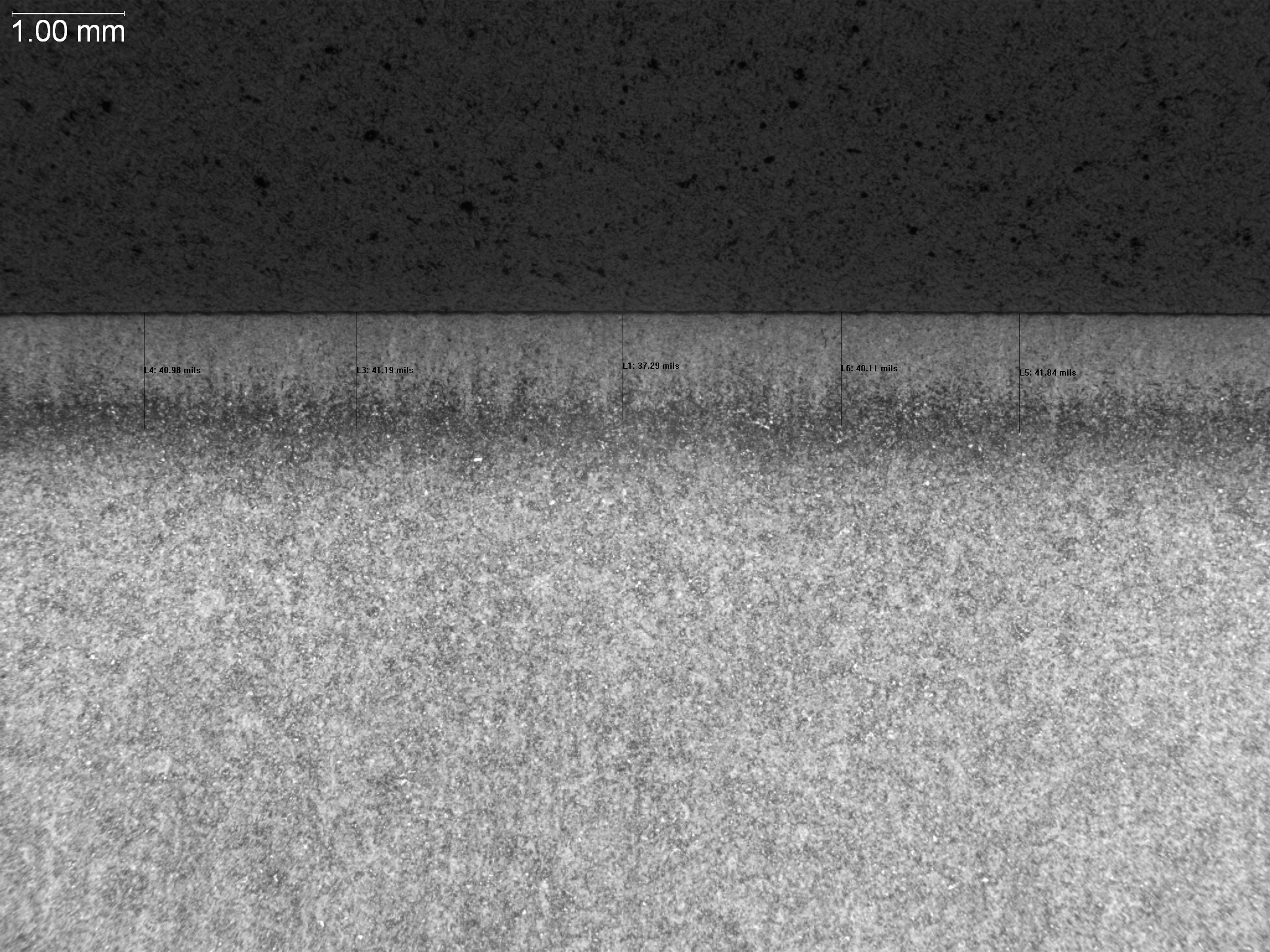
Metallographic Cross-Section Showing Case Depth in Carburized Component
This metallographic cross-section shows a carburized steel component with its hardened case layer (dark region at top) and softer core material (lighter region below). Measuring this case depth accurately is essential for aerospace, automotive, and industrial manufacturers who depend on surface-hardened components. Here's why it matters and how the testing process works.
When components fail in service, the failure often begins at the surface. That's why surface hardening treatments like carburizing, nitriding, and induction hardening have become essential processes across manufacturing industries. But how do you verify these treatments actually achieved their intended results? The answer lies in case depth analysis—a metallurgical testing method that measures how deeply a hardening treatment has penetrated into a component's surface.
What Is Case Depth?
Case depth refers to the distance from a component's surface to where the hardened layer transitions back to the softer core material. This hardened outer "case" provides wear resistance and fatigue strength, while the softer inner core maintains toughness and ductility. Think of it like a protective shell that prevents surface wear while keeping the interior flexible enough to absorb impact.
Metallurgists use several standardized methods to determine case depth, including:
- Total case depth: The distance from the surface to where the microstructure or hardness returns to the base material properties
- Effective case depth: The distance to a specific hardness level (commonly 50 HRC for carburized steels)
- Microstructural case depth: Determined by examining the transition in grain structure under a microscope
Why Case Depth Matters
Aerospace and Defense
In aerospace applications, precision is everything. Gears in aircraft transmissions, landing gear components, and turbine engine parts undergo carburizing or nitriding to achieve specific case depths. Too shallow, and the component wears prematurely or fails under cyclic loading. Too deep, and the part becomes brittle or dimensionally unstable. When you're dealing with components in flight-critical systems, case depth verification isn't optional—it's a matter of safety and regulatory compliance. At MSI Lab, we regularly perform case depth analysis for major aerospace manufacturers, supporting critical quality control programs for components destined for commercial and military aircraft.
Automotive Manufacturing
Modern automotive drivetrains depend heavily on case-hardened components. Transmission gears, differential components, and camshafts all require precise case depths to balance wear resistance with core toughness. As vehicles push toward higher performance and longer service intervals, manufacturers need tighter control over heat treating processes. Case depth analysis provides the data to verify that production heat treating cycles are consistently meeting specifications. Our laboratory works with major automotive manufacturers and their suppliers to ensure these critical drivetrain components meet exacting specifications.
Industrial Machinery
Heavy equipment operates in punishing environments where component failure means costly downtime. Hydraulic cylinders, bearing races, and wear-resistant tooling all benefit from controlled surface hardening. For manufacturers and rebuild shops, case depth testing confirms that components—whether new or refurbished—will stand up to demanding service conditions.
The Testing Process
Case depth analysis typically involves sectioning a sample from the component, mounting it in resin, and polishing the cross-section to a mirror finish. From there, metallurgists use one of two primary approaches:
Microhardness traverses involve taking a series of hardness measurements from the surface inward at specified intervals (often as small as 0.05mm). This creates a hardness profile showing exactly how the hardness transitions from the case to the core. The data is then compared against specification requirements.
Metallographic examination reveals the microstructural changes through etching and microscopic analysis. This method is particularly valuable for nitrided cases or when specifications call for specific microstructures rather than hardness values.
When Testing Becomes Critical
Case depth analysis is essential in several scenarios:
- Process qualification: When setting up a new heat treating cycle, testing confirms the process achieves the intended case depth before production begins
- Production verification: Regular sampling ensures ongoing process control and catches equipment or process drift before it affects large production runs
- Failure analysis: When components fail prematurely, case depth measurement often reveals whether improper heat treating contributed to the failure
- Material certification: Many quality standards and customer specifications require documented case depth verification for delivered components
The Bottom Line
Surface hardening treatments represent a significant investment in component performance and longevity. Case depth analysis provides the only reliable way to verify that investment achieved its intended result. Whether you're qualifying a new process, maintaining quality control in production, or investigating a component failure, accurate case depth measurement gives you the data needed to make informed decisions.
At MSI Lab, we perform case depth analysis in accordance with ASTM E384 for microhardness testing and ASTM E3-11 for metallographic preparation. Our A2LA ISO 17025 accreditation and GE S-400 certification ensure that your test results meet the highest standards for accuracy and traceability. We regularly provide case depth testing services for major aerospace, automotive, and industrial manufacturers who depend on precise, reliable metallurgical analysis for their critical quality control programs. If you're working with carburized, nitrided, or induction-hardened components, we can help verify your case depths meet specification requirements.
Have questions about case depth testing for your components? Contact MSI Lab at (937) 813-4878 or info@msilab.com to discuss your testing needs.