
Alpha Case in Titanium: Why Aerospace Manufacturers Need Accurate Measurement and Removal Validation
Titanium's exceptional strength-to-weight ratio makes it indispensable for aerospace applications—but heat treatment and welding operations create a surface defect that can compromise these very properties. Alpha case, a hardened oxygen-enriched layer that forms during high-temperature processing, reduces ductility and fatigue resistance in titanium components. At Metallurgical Solutions, Inc. (MSI Lab) we help aerospace manufacturers validate their heat treatment processes and verify alpha case removal, providing the precise measurements quality managers need to ensure components meet specifications.
What is Alpha Case?
Alpha case forms when titanium alloys are exposed to oxygen, nitrogen, or hydrogen at elevated temperatures. During heat treatment, forging, or welding operations, these elements diffuse into the surface, creating a hard, brittle layer with dramatically different properties.
The alpha case layer exhibits several problematic characteristics:
Increased Hardness: The oxygen-enriched surface can be 50-100% harder than base material, creating a brittle zone susceptible to cracking.
Reduced Ductility: The hardened layer loses the ductility that makes titanium valuable for aerospace applications.
Decreased Fatigue Resistance: Research in Materials Science and Engineering demonstrates that alpha case significantly reduces fatigue life in titanium alloys under cyclic loading.
For aerospace components subjected to high stresses and vibration—turbine blades, fasteners, landing gear, and structural elements—alpha case creates dangerous failure initiation sites that must be removed.
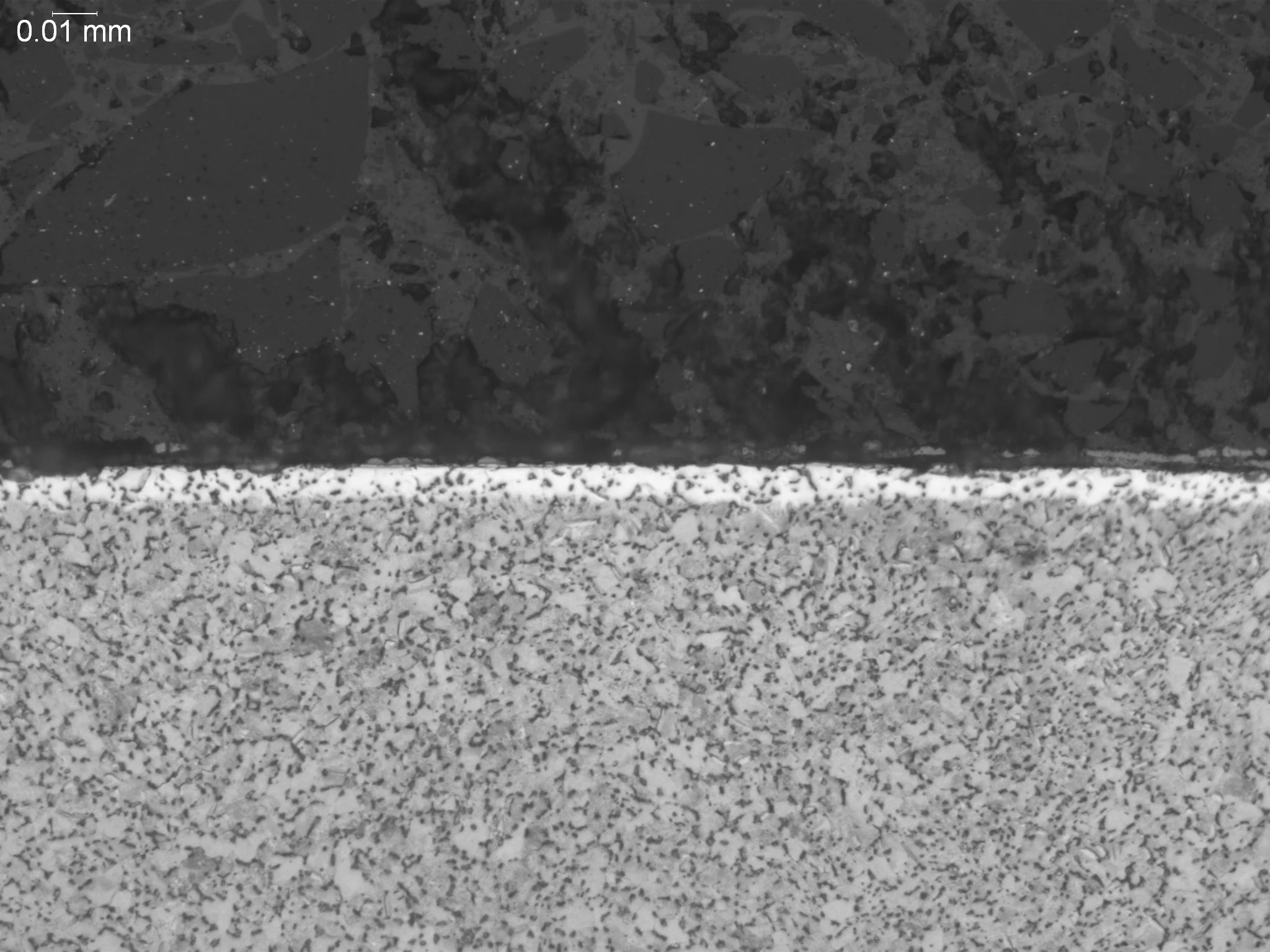
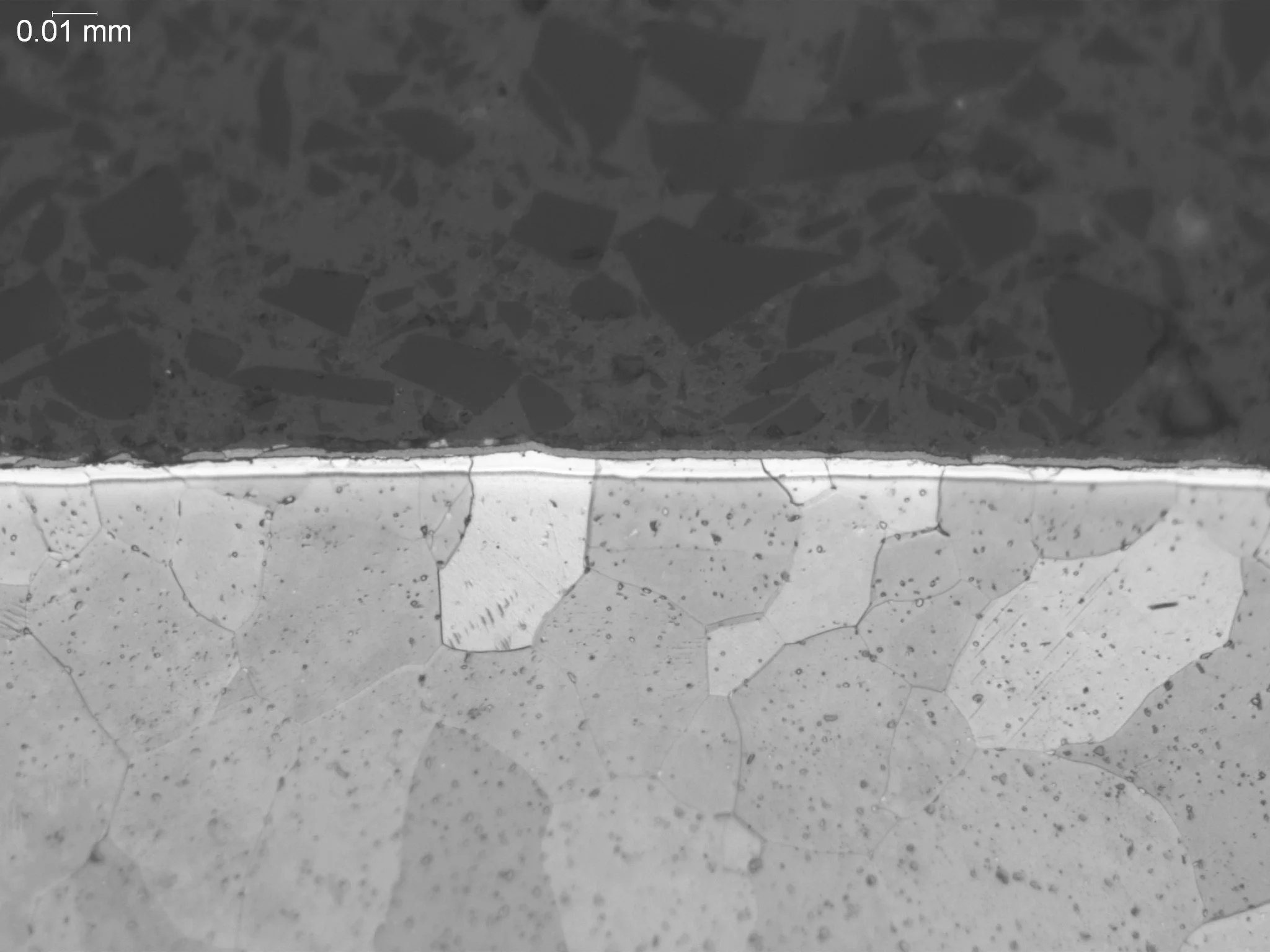
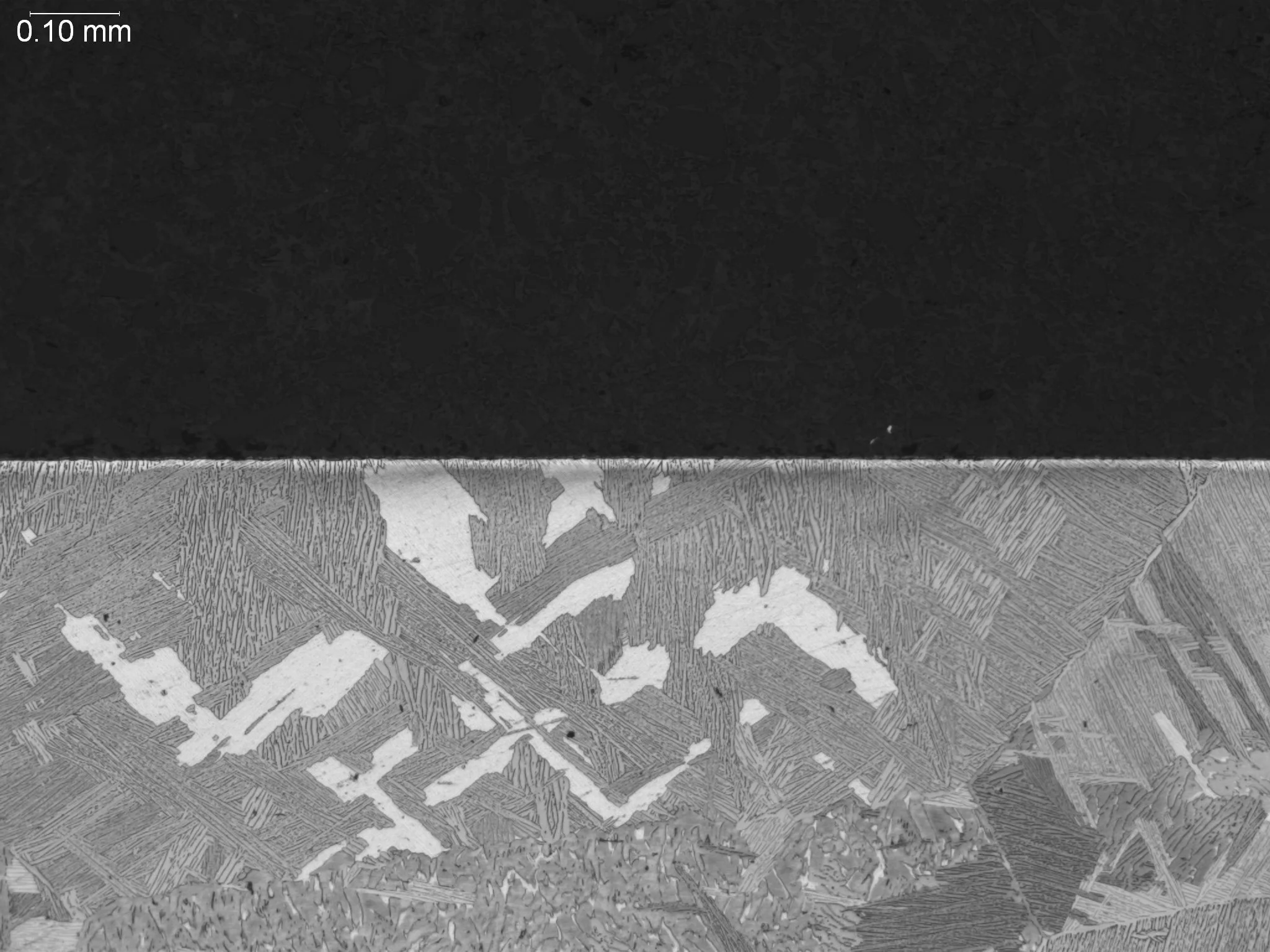
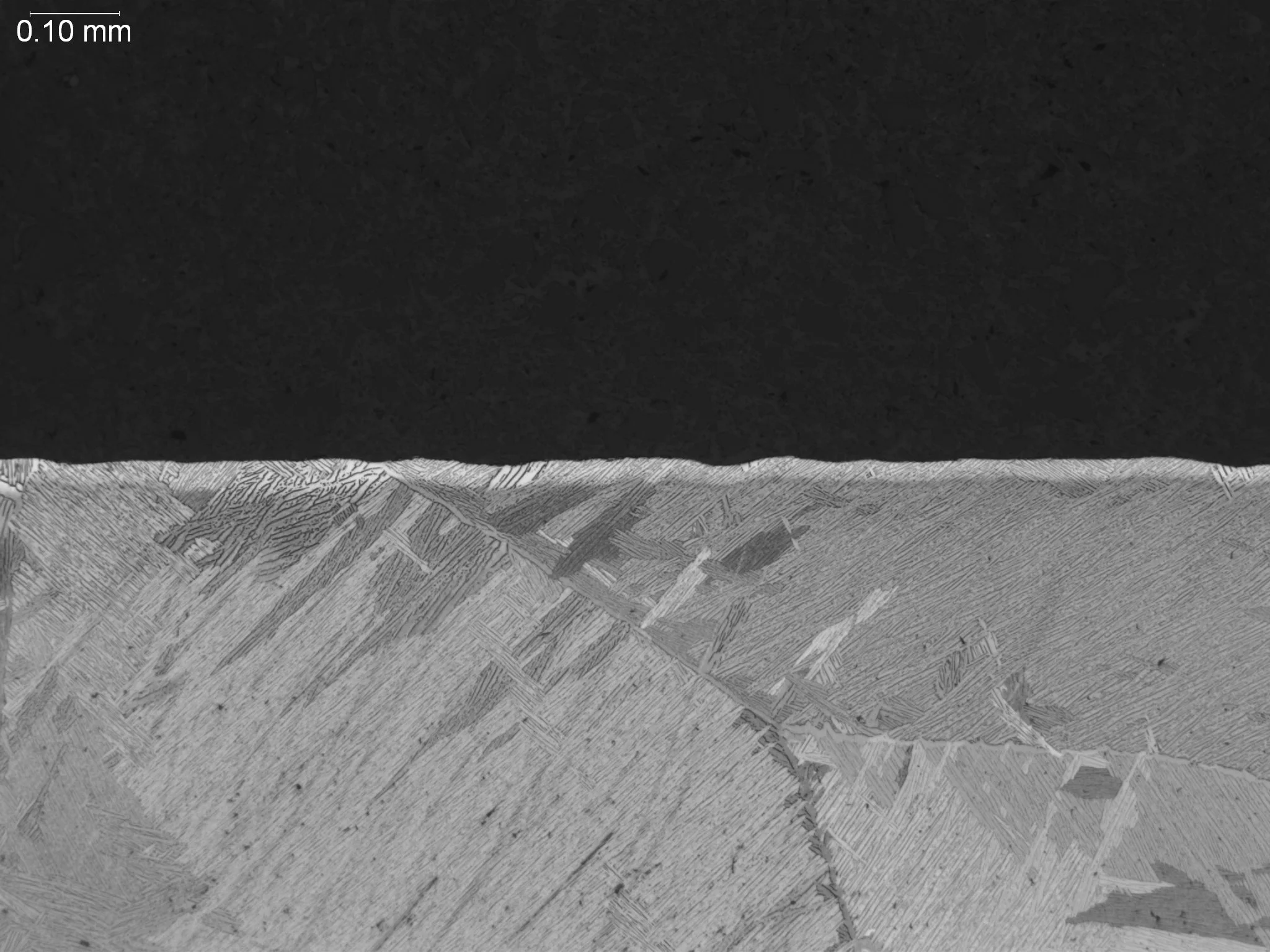
See below for photomicrographic examples of alpha case on titanium from our lab. View our Gallery page for more examples of what we do!
Why Alpha Case Testing Matters for Aerospace Quality Managers
Aerospace specifications explicitly address alpha case because of its impact on component reliability. Quality managers face stringent requirements demanding verification:
Heat Treatment Process Validation: Manufacturers must verify their processes don't create excessive alpha case. Our metallographic analysis documents case depth, helping optimize furnace atmospheres and cycle times.
Removal Process Verification: Mechanical removal methods must eliminate the entire alpha case layer. Our precise depth measurements tell you exactly how much material to remove.
Supplier Qualification: When receiving heat-treated titanium from suppliers, verification testing confirms they've met alpha case removal specifications.
Failure Investigation: When components fail unexpectedly, alpha case often emerges as a contributing factor. Our analysis establishes whether inadequate case removal played a role.
MSI Lab's Alpha Case Testing Approach
Accurate alpha case measurement requires specialized metallographic techniques. Our comprehensive analysis provides quality managers with actionable data:
Cross-Sectional Metallography: We section titanium parts perpendicular to the suspected alpha case surface, mount specimens, and polish them to reveal the case layer. Proper etching clearly delineates the case boundary from base material.
Microhardness Traverses: We perform systematic hardness measurements from the surface into the base material, creating profiles that quantify property changes. These traverses definitively establish case depth based on the transition to base material hardness.
Precise Depth Measurement: Using calibrated microscopy, we measure alpha case depth at multiple locations, providing statistical analysis of thickness variation. This data tells you exactly how much material must be removed.
Specification Comparison: Our reports compare measured case depths to applicable aerospace specifications, clearly stating pass/fail status and providing the documentation needed for acceptance decisions.
Common Alpha Case Scenarios in Aerospace Manufacturing
Heat Treatment Development: When optimizing heat treatment parameters for new titanium alloys, manufacturers need to understand how different furnace conditions affect alpha case formation. Our analysis helps balance desired mechanical properties with minimal surface degradation.
Furnace Atmosphere Qualification: Vacuum furnaces, inert atmosphere furnaces, and air furnaces create different levels of alpha case. We verify your furnace atmosphere adequately protects titanium surfaces.
Chemical Milling Validation: Chemical milling removes alpha case without introducing mechanical stresses. Our testing validates that your etch depths consistently eliminate the case layer.
Welding Process Control: Welding operations create alpha case in heat-affected zones. We help you develop appropriate post-weld processing procedures.
Alpha Case Requirements in Aerospace Specifications
Aerospace manufacturers must comply with stringent specifications addressing alpha case. AMS (Aerospace Material Specifications) often limit case depth or require complete removal. Major aerospace OEMs including Boeing, Airbus, and General Electric maintain proprietary specifications for titanium processing with strict alpha case limits based on component criticality.
MSI Lab's GE S-400 certification and A2LA ISO 17025 accreditation ensure our alpha case testing meets these demanding aerospace standards. Located near Wright-Patterson Air Force Base, we understand the documentation and traceability requirements defense contractors face.
The Science Behind Alpha Case Formation
At elevated temperatures, oxygen diffuses into the titanium surface, forming a solid solution with the alpha phase. The rate of case formation depends on temperature, time, and oxygen partial pressure in the atmosphere.
The case depth follows a parabolic relationship with time and temperature. This time-temperature relationship allows process engineers to predict case formation and design removal procedures accordingly.
Studies have demonstrated that alpha case as thin as 0.001-0.002" significantly reduces fatigue life in titanium alloys by creating crack initiation sites. A study published in Materials Science and Engineering found that even a 2μm thick alpha-case layer reduced low cycle fatigue life by approximately 50% in Ti-6Al-2Sn-4Zr-2Mo alloy under higher strain conditions.
Local Expertise for Ohio Aerospace Manufacturers
MSI Lab's Dayton location provides aerospace manufacturers throughout the region with convenient access to expert alpha case analysis. Our metallurgists understand titanium alloy behavior, heat treatment effects, and aerospace specification requirements.
Take Action on Titanium Quality
If you're heat treating or welding titanium components for aerospace applications, alpha case testing provides essential process validation. Metallographic analysis gives you the precise data needed for confident acceptance decisions.
Contact MSI Lab at (937) 813-4878 or visit us at 331 E. Helena Street, Dayton, OH 45404 to discuss your alpha case testing requirements.
Reference
Zheng, Z., Balint, D.S., Dunne, F.P.E. (2014). "Influence of alpha-case layer on the low cycle fatigue properties of Ti-6Al-2Sn-4Zr-2Mo alloy." Materials Science and Engineering: A, 609, 397-401. https://www.sciencedirect.com/science/article/abs/pii/S0921509314000902